
The perfume itself is the easy half of an OEM project; the document trail is where projects stall. Every market you sell into expects certain proofs — ingredient restrictions, safety assessment, labelling, notification — and most of that paperwork has to be built from factory documents that exist before the first bottle ships. A brand that lists its compliance needs in the RFQ gets a factory that can actually document it; a brand that does not discovers the gap at customs.
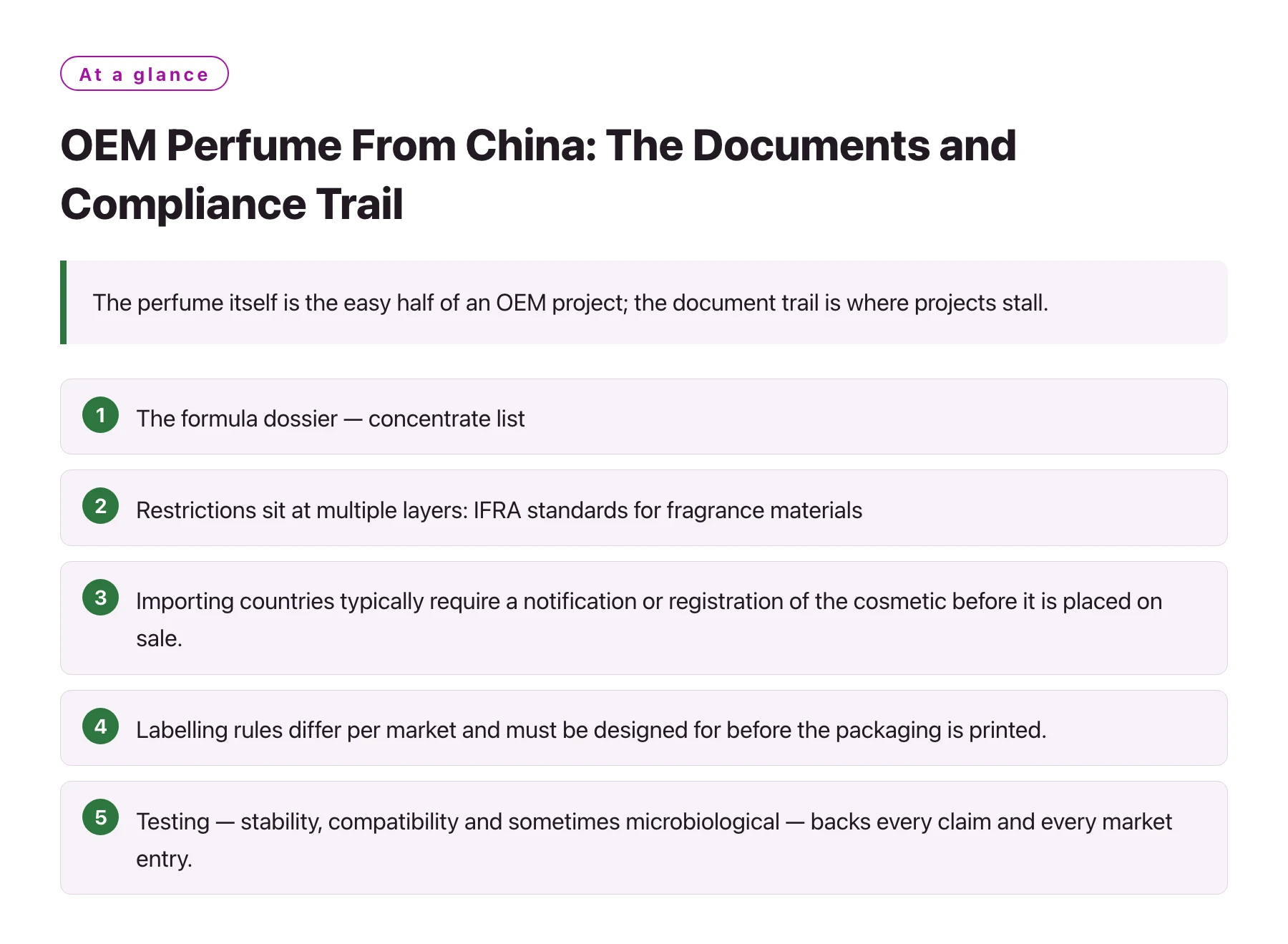
Key takeaways
- The formula dossier — concentrate list, material safety data, concentrations — is the master document every market trail starts from.
- Restrictions sit at multiple layers: IFRA standards for fragrance materials, and national ingredient rules for the finished cosmetic.
- Importing countries typically require a notification or registration of the cosmetic before it is placed on sale.
- Labelling rules differ per market and must be designed for before the packaging is printed.
- Testing — stability, compatibility and sometimes microbiological — backs every claim and every market entry.
First-time importers of OEM perfume usually spend the whole project worried about the scent and arrive at the finish line with the paperwork untouched. The customs hold, the retailer compliance check or the marketplace listing rejection that follows is almost always a documentation problem, not a product problem.
The fix is boring and cheap: decide the compliance targets before the RFQ, and let the document trail shape the factory conversation from the start. This article walks through the documents, the market differences and the questions that belong in your RFQ.
The master documents
The formula dossier
Everything downstream starts from the formula dossier: the concentrate list, the concentrations, the material safety data sheets, and the manufacturer's batch traceability. The dossier is compiled by the factory, but the buyer owns the right to a complete copy — encrypt it, version it, and treat it as the reference every later document points back to.
The production model matters for how the dossier is built. A manufacturer that supports OEM and ODM will compile your formula file differently depending on the route: your own formula under OEM, or a library base under ODM — ask at the start which file you are actually getting a manufacturer that supports OEM and ODM.
The ingredient register
Restrictions come from two layers. The EU CosIng database is the reference for which cosmetic ingredients are restricted or banned in the EU, and it is worth consulting even for non-EU markets as a conservative baseline [1]. On top of that, the IFRA Standards Library defines fragrance-specific restrictions by ingredient and product category, and a factory that sells internationally keeps every formula mapped against it [2].
The market trail, side by side
| Market | Core compliance step | Documents you need |
|---|---|---|
| European Union | Cosmetic notification before placing on market | Formula, safety assessment, label, packaging file |
| United States | Responsible person duties and ingredient labelling | Ingredient list, allergen and labelling file |
| Canada | Cosmetic notification before sale | Notification form, ingredient list, safety data [3] |
| United Kingdom | Separate UK notification since leaving the EU | UK notification file, same underlying dossier |
| China (export side) | Manufacturer permits and export documentation | GMP certificates, export and customs files |
The pattern to notice: none of these is a one-off certificate. Each is a living file that updates whenever the formula, the label or the pack changes — which is why the factory's version control deserves your attention.
The testing layer
Testing sits underneath the document trail. Stability testing shows the product holds up over time; compatibility testing verifies the formula against your bottle, cap and pump rather than the factory's standard pack; and some formats or markets add microbiological testing. Each test produces the evidence that a market file references, so the testing scope should be set with the destination market open on the table.
A practical note on ODM-style projects: if the scent comes from the factory's own library — the route of an ODM partner for fragrance brands — ask whether the base already carries stability and safety data, because existing evidence on an unchanged base can shorten your market-entry file considerably an ODM partner for fragrance brands.
Putting compliance into the RFQ
Write the compliance questions into the RFQ, not into a later email: does the factory compile a per-market formula dossier; can it supply a safety-assessor-ready file; does it maintain IFRA documentation per formula; what tests does it run as standard; and what do samples ship with? The answers separate factories that export from factories that merely produce.
For brands sourcing in southern China, OEM perfume production in Guangzhou is where most of these files are actually compiled — and the depth of a factory's compliance experience shows directly in how precisely it answers these questions OEM perfume production in Guangzhou. Keep the answers in the written file; oral assurances do not clear customs.
One test separates factories that can export from factories that can document: ask what the last three markets they shipped to required. A factory that answers with countries and files is ready. A factory that answers with a smile is not.
Sources
- EU CosIng — Cosmetic Ingredient Database (European Commission) —— The European Commission's CosIng database of cosmetic ingredients, listing ingredient functions, restrictions and labelling requirements under EU cosmetics law.
- IFRA Standards Library (International Fragrance Association) —— The IFRA Standards Library lists the restrictions the fragrance industry applies to individual fragrance ingredients, based on safety assessments; it is the reference point for compliant fragrance formulation.
- Health Canada: Cosmetic Safety —— Health Canada's cosmetics pages, covering cosmetic notification, the ingredient hotlist and safety requirements for cosmetics sold in Canada.
Frequently asked questions
Who is responsible for compliance, the brand or the factory?
Legally, the party placing the product on the market — usually the importer or brand — carries the responsibility. The factory supplies the underlying documents. Both roles matter, but the accountability sits with the brand in most markets.
What is a safety assessment and who writes it?
A safety assessment is the expert report that confirms a finished cosmetic is safe, produced from the formula and ingredient data. It is written by a qualified safety assessor and is a core file for EU and several other markets.
Do I need IFRA compliance for every market?
IFRA standards are voluntarily adopted industry guidance that most serious brands follow globally, and many retailers require them. It is the pragmatic baseline even where it is not legally mandated.
How long does compliance documentation take?
Plan for weeks, not days, once the formula is final — especially the first time, when the dossier structure has to be built. Reorders are faster because the living files already exist.
Can one factory's documents cover several markets?
Mostly yes, with per-market adjustments. The formula dossier is shared; the notifications, labelling and some tests are market-specific. A factory with multi-market export experience will hand you the deltas instead of making you discover them.