
Will One Small Miner Reach 0.001 BTC in Its First Month?
A first month is a poor unit for judging a small miner and a useful one for judging expectations. At 50 TH/s the rig credits about 0.000673 BTC in 30 days, short of 0.001; at 100 TH/s it clears the target on day 23. The difference is not luck, it is the size of the machine.

Key takeaways
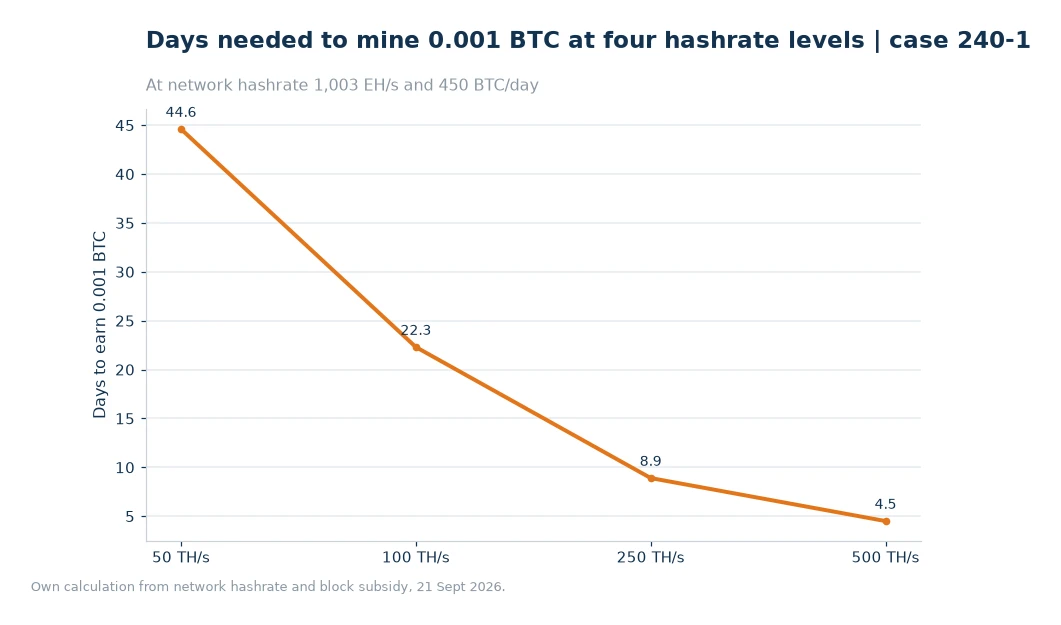
- At 50 TH/s, 30 days produce about 0.000673 BTC; the 0.001 BTC mark arrives around day 44.6.
- At 100 TH/s the same target lands on day 22.3, and at 500 TH/s on day 4.5.
- Pool Hashrate decides the divisor, so a first-month estimate should be recalculated after the first difficulty adjustment.
- Pool Luck can move a single month by enough to matter, which is why the first review should happen after 30 days, not after 3.
The month is the wrong unit for some rigs
New owners tend to measure mining in months because bills arrive monthly. The hardware does not share that rhythm. A small rig may take six weeks to reach a round number, and a large one may pass it before the first electricity bill is due. Choosing a month as the scorecard guarantees that some owners will feel disappointed by a result that is exactly on plan.
The honest first-month question is narrower: did the machine deliver the shares it should have delivered? That is answerable in a week. Whether the balance looks impressive is a separate question, and it depends on the size of the machine rather than on the quality of the setup.
What 50 TH/s actually credits
At a network total of 1,003 EH/s, each terahash earns 0.00000044865 BTC a day. Fifty of them earn 0.00002243, which is $1.90 at $84,692. Over 30 days that is 0.000673 BTC, or $57. At that pace the 0.001 BTC mark arrives at 44.6 days, roughly two weeks into the second month.
None of that is a fault. It is what one small machine is worth against a network of a million. The useful conclusion is that a 50 TH/s unit should be judged on its cost per day and its uptime, not on whether it produced a round number before the first invoice arrived.
Pool Hashrate, read once and then left alone
The ViaBTC Pool Hashrate figure can become a distraction in month one. The number moves constantly, and watching it does not change your credit. Read it once to record the network total you are dividing by, then set a weekly reminder instead of a live tab.
The number is still worth recording because it is the only way to explain a change later. If your balance in month two is 6% below month one and your delivered hashrate has not moved, the likely cause is a 6% rise in the network total. Without the recorded figure, that explanation is a guess; with it, the cause is visible in two lines.
Pool Luck will not rescue a first month
A new miner on PPLNS may see a lump sum arrive early and conclude that the machine is outperforming. A new miner on PPS+ may see a smooth line and conclude that nothing interesting is happening. Both are seeing the settlement scheme rather than the machine. Pool Luck is real, but it is a variation around the expected output, not a substitute for it.
The first month is also when configuration errors are most likely. A worker name that was never applied, a backup pool that took over silently, or a payout address typed with one wrong character can each distort the result. Check the pool-side worker list and the address before you check the balance.
Four rigs against a 30-day window
The table asks a simple question of four sizes: after 30 days, is the first 0.001 BTC already in the account?
| Rig size | BTC per day | Days to 0.001 BTC | BTC at day 30 | Target met by day 30 |
|---|---|---|---|---|
| 50 TH/s | 0.00002243 | 44.6 | 0.000673 | No |
| 100 TH/s | 0.00004487 | 22.3 | 0.001346 | Yes, on day 23 |
| 250 TH/s | 0.00011216 | 8.9 | 0.003365 | Yes, on day 9 |
| 500 TH/s | 0.00022433 | 4.5 | 0.006730 | Yes, on day 5 |
Two of the rows finish in the first week, one finishes in the third, and one needs a second month. If the target was chosen to coincide with a monthly review, only the smallest rig fails the test, and it fails by about 33% rather than by a rounding error.
A five-column table is more than a first-month buyer needs, so read just two of them: the daily credit and the days column. The other three exist to stop the first two from being read in isolation. A rig that clears the threshold on day five has not earned more per day than one that clears it on day nine; it simply has more terahashes behind it.
A better first goal than a coin count
For the first thirty days, aim for three things that a small rig can actually deliver: a stable delivered hashrate within 5% of the label, a share rejection rate low enough to ignore, and a power draw measured at the wall rather than assumed. Those three make every later calculation trustworthy, which is worth more than a round number in the wallet.
Add a fourth: a written note of the pool, the worker name and the payout address. If the machine is moved or the router is replaced, that note saves an evening. It also makes the second machine easier to set up, because the first one already documented the decisions.
Finally, resist the urge to compare your month with a stranger's screenshot. The screenshot usually omits the hashrate, the tariff and the start date, which are the only three facts that would make it comparable. Your own record, even a modest one, is a better benchmark because you know exactly what produced it.
Worked example
Check the smallest rig against a 30-day month, then confirm the 100 TH/s case.
- The global rate is 450 ÷ 1,003,000,000 = 0.00000044865 BTC per TH/s.
- Multiply by 50: 50 × 0.00000044865 = 0.00002243 BTC daily.
- Thirty days: 0.00002243 × 30 = 0.000673 BTC, about $57 at $84,692.
- Days to 0.001 BTC: 0.001 ÷ 0.00002243 = 44.6.
- At 100 TH/s: 0.00004487 BTC a day, so 30 days gives 0.001346 BTC.
- Days to 0.001 BTC at 100 TH/s: 0.001 ÷ 0.00004487 = 22.3.
Frequently asked questions
Will a 50 TH/s miner reach 0.001 BTC in a month?
No. It credits about 0.00002243 BTC a day, so 30 days gives 0.000673 BTC and the target arrives at about day 44.6.
How long should I wait before judging a new miner?
Judge the setup after a week by checking delivered hashrate, rejected shares and power at the wall; judge the output after 30 days, when the daily variation has had time to average out.
Why is my balance lower than the formula predicts?
Common causes are a network total that rose after your estimate, a delivered hashrate below the label, or downtime. Pool Luck can also contribute, especially under PPLNS, where six confirmations and the last five difficulty rounds shape the timing.
Score the setup, not the first invoice
On day seven, compare three numbers: the hashrate the pool reports, the hashrate on the label, and the watts at the wall. If the first is close to the second and the third is close to your assumption, the machine is doing its job. The balance will follow the calendar you calculated, not the other way around.
The ViaBTC App makes the weekly check quick, and the pricing page explains the listed rates behind the credit. Set the reminder for the same day each week and let the small numbers accumulate.
Sources: ViaBTC pool state, app and pricing pages; chain inputs read 21 Sept 2026: network hashrate 1,003 EH/s, difficulty 132.76 T, subsidy 3.125 BTC per block, 144 blocks a day, BTC $84,692. Thirty-day figures assume continuous operation. Figures read 21 Sept 2026, published 24 Oct 2026[1].